Prescriptive Analytics
Lesson opener
In one line: Prescriptive analytics recommends actions that optimise an objective under constraints and uncertainty — not just forecasts.
Why it matters: A demand forecast without an order quantity leaves ops guessing. Prescriptive work turns uncertainty into a defendable decision (order qty, budget split, staffing).
Before this lesson: Predictive analytics; Operations analytics for inventory context.
Goal
Recommend actions that optimize an objective under constraints and uncertainty.
What you will be able to do
- State objective, decision variables, constraints, and uncertainty for a workplace problem.
- Apply newsvendor intuition (understock vs overstock costs) and a simple Monte Carlo.
- Connect A/B lift to a roll-out prescription when practical significance clears the bar.
Decision framework
- Objective — maximize profit, minimize cost, maximize service level
- Decision variables — order quantity, staffing level, price
- Constraints — budget, capacity, minimum service
- Uncertainty — demand, lead time, conversion rate
Newsvendor intuition (operations)
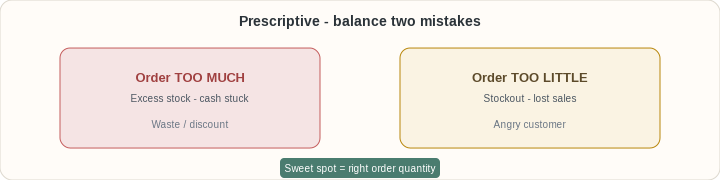
Single-period inventory with uncertain demand:
- Under-order → lost sales (cost of understock)
- Over-order → salvage or waste (cost of overstock)
Critical ratio: order up to quantity where
\( P(\text{demand} \leq Q^*) = \frac{C_u}{C_u + C_o} \)
(Cu = understock cost, Co = overstock cost per unit)
Simulation
When math is messy, simulate many scenarios:
import numpy as np

demand = np.random.normal(loc=1000, scale=200, size=10_000)
order_qty = 1100
profit = np.where(demand <= order_qty,
                  demand * 5 - order_qty * 3,
                  order_qty * 5 - order_qty * 3)  # simplified
print("Expected profit:", profit.mean())
Linear optimization (concept)
Maximize \( c^T x \) subject to \( A x \leq b \), \( x \geq 0 \)
Example: allocate marketing budget across channels with diminishing returns caps.
Tools: Excel Solver, Python scipy.optimize, specialized solvers.
Decision trees (decision analysis)
Square = decision, circle = chance, triangle = outcome.
Expected value at chance nodes = probability-weighted sum of branches.
A/B testing → prescriptive
If variant B lifts conversion with p < 0.05 and practical significance > 2%, prescribe roll out B.
Teacher walkthrough: order quantity for SKU P12
All figures illustrative.
NovaRetail must set a one-period order for festival SKU P12.
Step 1 — Objective: maximise expected contribution (not units sold).
Step 2 — Costs: Cu (understock) = lost margin ₹200/unit; Co (overstock) = holding/salvage loss ₹50/unit. Critical ratio = 200/(200+50) = 0.80 → target the 80th percentile of demand.
Step 3 — Uncertainty: simulate demand ~ Normal(1000, 200) as in the sample block (figures illustrative).
Step 4 — Compare Q options: evaluate expected profit at Q = 900, 1100, 1300; pick the best under the same cost model.
Step 5 — Prescribe: "Order 1,100; expected profit beats neighbours; risk: left-tail demand week — hold 50 units safety if lead time allows."
Failure example: ordered the forecast mean
Symptom: Team ordered μ = 1,000 every week. Stockouts on high-margin weeks; excess on quiet weeks.
Diagnosis: Mean ignores asymmetric costs. When Cu ≫ Co, optimal Q sits above the mean.
Correction: Compute critical ratio; simulate; report expected profit and stockout probability.
Validation: After switching to critical-ratio Q, fill rate on P12 rises without proportional overstock cost (illustrative).
Guided practice
Cu = ₹300, Co = ₹100. What critical ratio, and do you order above or below median demand?
Complete solution: 300/(300+100) = 0.75 → order at roughly the 75th percentile — above the median when demand is roughly symmetric.
Independent practice
Acceptance criteria:
- Objective, decision variable, one constraint, one uncertainty source for a real or NovaRetail problem.
- Monte Carlo (or spreadsheet equivalent) comparing at least two actions.
- One sentence on expected value vs a worst-case risk you would report to a manager.
- Link to when A/B results become a prescription (Statistics reference / Exercise 8).
Common mistakes
- Treating the forecast as the order quantity.
- Optimising units sold instead of profit or service under cost.
- Ignoring constraints (budget, capacity, MOQ).
- Prescribing roll-out from lift without sample-size / practical significance checks.
Practice
Do this now (click): Open Exercise 3 — Newsvendor simulation →
Data: data/operations.csv (website → Data preview)
Checklist
- [ ] I stated objective, decision, and one constraint for a real problem
- [ ] I ran a simple Monte Carlo simulation
- [ ] I interpreted expected value vs risk (worst-case scenario)
- [ ] Acceptance criteria above are met